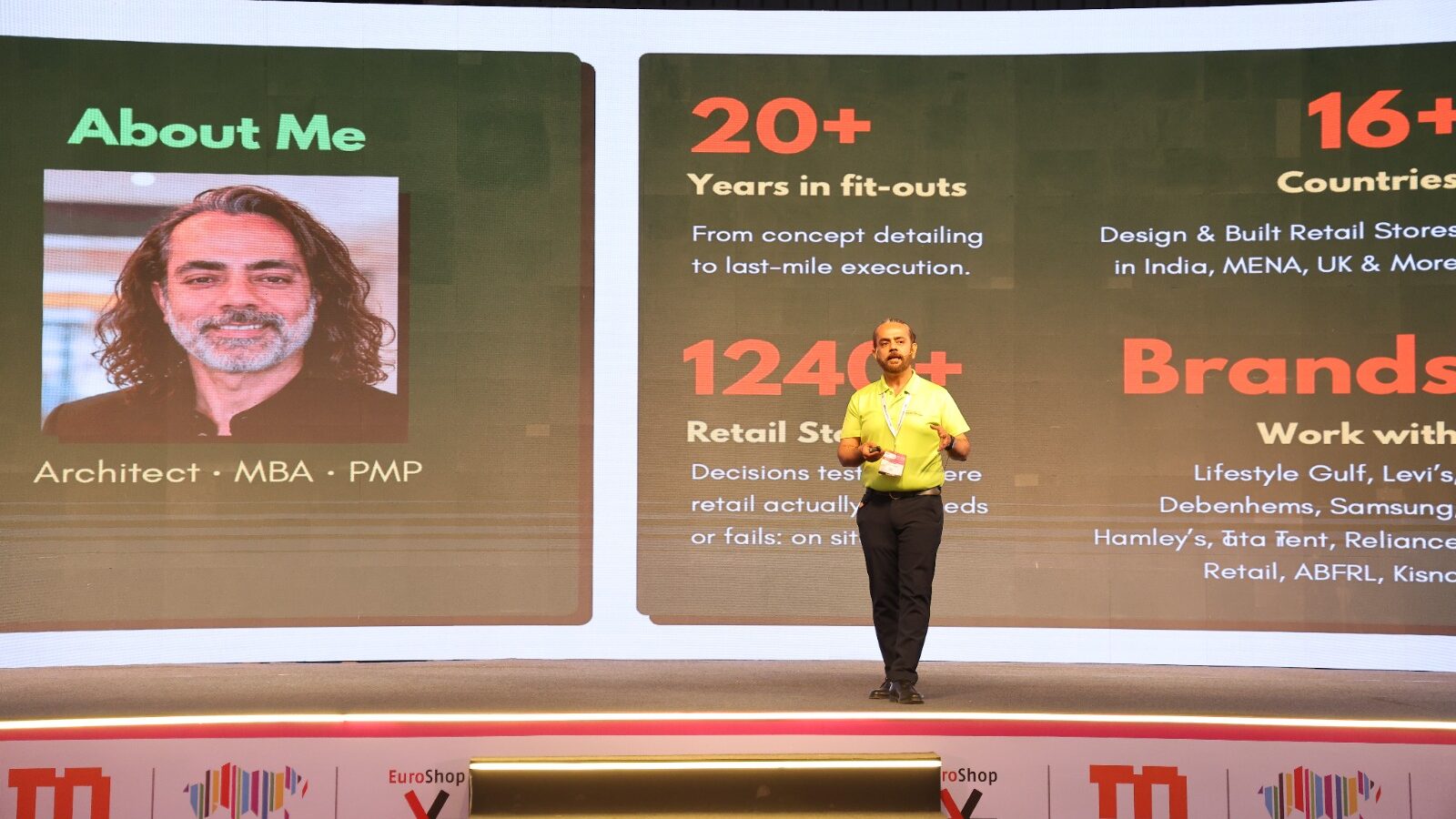
Retail brands today are investing heavily in better store concepts, customer experiences, visual merchandising, and aggressive expansion plans. But despite strong retail ideas and well-designed store formats, many projects still struggle with delayed openings, cost overruns, inconsistent execution, and coordination gaps on-site.
During my session at In-Store Asia 2026, I spoke about one of the biggest challenges in modern retail expansion:
“The Execution Gap: Why Great Retail Ideas Fail on the Ground”
Over the last 20+ years in retail fit-outs and project management, I have observed that retail is not facing a shortage of ideas. Retail is facing a shortage of repeatable execution systems.
Today, brands can create impressive store concepts, but scaling those concepts consistently across multiple locations remains one of the biggest operational challenges in retail execution.
Why Retail Store Execution Still Fails
Many people assume retail project delays happen because of problems during site execution. In reality, most rollout delays begin much earlier.
One of the key points I discussed during the presentation was this:
“Most rollout delays are created before execution even starts.”
In retail store rollout projects, delays are often caused by:
- Incomplete property readiness
- Delayed approvals and landlord dependencies
- Weak procurement planning
- Design ambiguities
- Poor interdepartmental coordination
- Lack of rollout visibility
By the time execution teams arrive on-site, the project may already be carrying hidden delays and operational risks.
This is one of the biggest reasons why many retail expansion projects struggle to achieve predictable timelines.
Does Standardization Guarantee Faster Retail Rollout?
Retail brands often believe standardized store formats automatically improve execution speed.
However, standardized design does not always guarantee standardized execution.
Every retail site behaves differently because of:
- Civil readiness conditions
- Mall coordination challenges
- Existing services and utilities
- Power availability
- Local vendor ecosystems
- Site-specific execution constraints
This is why even highly standardized retail formats can experience huge opening timeline variations.
Replication may look simple in drawings, but real retail rollout execution happens property-by-property, site-by-site.
In my experience, this is where the actual execution gap begins.
Why Faster Store Opening Matters in Retail Expansion
Modern retail growth is no longer only about opening more stores.
It is about opening stores faster, more predictably, and more profitably.
During the session, I used examples of large retail networks such as Lenskart to explain how execution speed directly impacts business growth.
Faster retail rollout helps brands:
- Start revenue generation earlier
- Improve ROI timelines
- Reduce operational uncertainty
- Scale expansion faster
- Maintain stronger market momentum
Retail execution speed is no longer just an operations metric. It has become a competitive business advantage.
Speed in Retail Fit-Outs Is Possible
One of the biggest misconceptions in retail project management is that ultra-fast rollout is unrealistic.
In reality, faster execution becomes possible when systems are designed correctly.
During my presentation, I shared several examples that prove this:
- A 57-storey structure completed in 19 days as an example of system-driven execution capability
- A 2,000 sq.ft retail format delivered in 10 days in India
- Experience of being part of teams delivering nearly 220 stores per month during COVID
- Personally delivering a retail store in 8 days during my early site execution experience
These examples are important because they challenge the belief that retail delays are unavoidable.
In my experience, speed in retail fit-outs is usually achieved through:
- better systems,
- centralized visibility,
- procurement alignment,
- parallel execution,
- and rollout predictability.
The Biggest Reasons Behind Retail Execution Delays
During the session, I discussed three major reasons why retail execution projects fail.
1. Siloed Retail Execution
Many retail organizations still work in disconnected departments where design, procurement, and execution teams function separately.
This creates:
- coordination gaps,
- delayed decisions,
- fragmented accountability,
- and slower rollout execution.
Projects begin moving function-by-function instead of store-by-store.
2. Site Reality Is Discovered Too Late
Another major issue in retail project management is delayed site discovery.
Problems such as:
- service clashes,
- incorrect measurements,
- power readiness limitations,
- and civil constraints
often appear after execution begins.
This leads to revisions, cost increases, and timeline extensions.
3. Procurement Is Treated as Buying Instead of Planning
Procurement is one of the most underestimated aspects of retail rollout planning.
Without procurement alignment:
- long-lead materials arrive late,
- fixtures dispatch incomplete,
- installation sequences fail,
- and site momentum slows down.
In high-speed retail rollout projects, procurement planning becomes a critical execution driver.
Building Better Retail Rollout Systems
One of the strongest points I shared during the session was this:
“Move from sequential handoffs to one integrated rollout engine.”
Retail execution improves significantly when brands focus on:
- Property readiness before closure
- Design-for-execution thinking
- Procurement planning linked to rollout schedules
- Centralized command-centre visibility
- Parallel execution systems
- Better coordination across teams
The goal is simple:
Predictable, scalable, and faster retail store openings.
Final Thoughts
I believe the future of retail expansion will not be defined only by better store concepts.
It will be defined by execution capability.
The brands that scale successfully over the next decade will be the ones that build:
- stronger rollout systems,
- faster execution frameworks,
- better coordination models,
- and more predictable retail delivery processes.
As I concluded during the session:
“Retail Expansion is not about opening more stores. It’s about opening them Predictably & Profitably.”
The complete presentation video from In-Store Asia 2026 will soon be available on my YouTube channel.
YouTube Link: https://www.youtube.com/watch?v=LGZTEdWM2Bg&t=37s